






Two years. That’s about how long people in Quebec typically wait before their case is heard at the Small Claims Division of the Court of Québec (often called “small claims court”). With the hope to improve access to justice, Éducaloi and Millénium Québecor held a competition to modernize – and humanize – the public’s experience at the small claims court using AI and legal design.
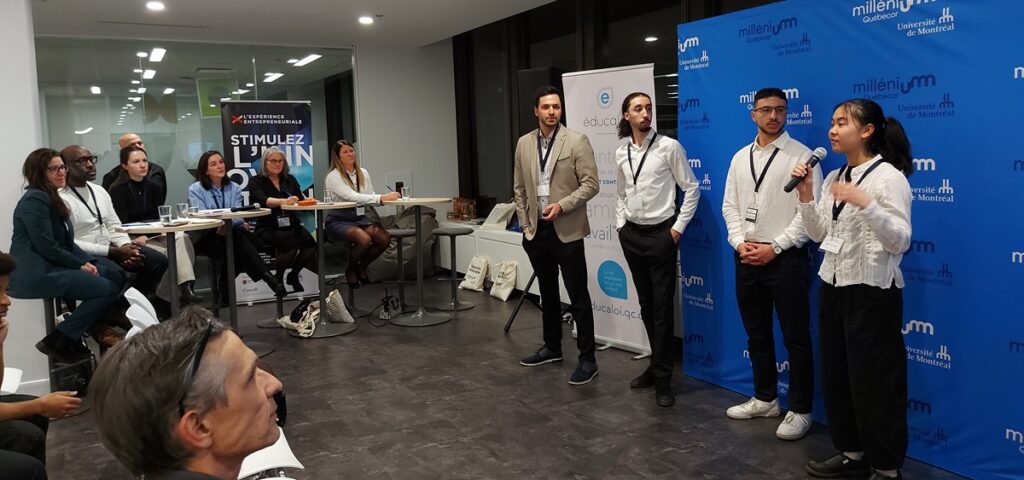
Three multidisciplinary teams of university students took part in the competition. Their mission: to come up with ideas of solutions to help someone prepare, file, track and understand their small claims court case. The catch: they had to integrate artificial intelligence (AI) and legal design to their solutions while preserving the process’s fairness and human touch!
On November 26, at the Ax.c Hub in Place Victoria, Montreal, the teams presented their ideas to the public and to a seven-person jury from the legal and entrepreneurial fields. Although all three proposed solutions were strong, the jury still had to choose just one winner.
It wasn’t an easy task: deliberations ran long, and in the end, the jury named one first-place team and two… second-place teams!
The winning team, MPC Inc., received $2,000, while the other two teams, Petite Justice and Éducréance, each received $1,500.
According to jury member Stéphan Parent, Director of Special projects at Novom, the winning solution stood out because of how reliable it is.
“They came up with a broad, robust solution,” explains Parent. “They were the team we had the fewest uncertainties about.”
A “symbolic” AI
The winning team includes law student Sophie Fan and mathematics and computer science students Yassine Chahdi, François Frigon, and Rayane Mili. They chose not to build their solution around generative AI like ChatGPT. No chatbot, no large language model. Why? To avoid hallucinations, reduce cost, improve performance, and minimize environmental impact.
Instead, their proposed solution, “Mes petites créances” (My small claims), is built on what they call a “symbolic” AI.
“The main concern we had was the risk of giving legal advice. We wondered whether that would even be legal,” said François Frigon, who also studied management.
To prevent incorrect or misleading legal information from being generated, the team chose to go with a rule-based system with tightly controlled outputs.
The solution’s main goal is to help people prepare their file before they go to small claims court. “The information exists. And there are websites out there, like Éducaloi,” said Sophie Fan. “But people really struggle to navigate the Quebec legal ecosystem. The information is scattered and dense.”
For many people who are looking for legal information, understanding it is the biggest challenge. And the challenge is made even harder because of the stress they’re living.
How could the winning team’s solution help relieve pressure on the small claims court? By reducing the number of rejected files and increasing the number of people who turn to mediation first. “It lowers the administrative burden,” explained Frigon. “Our solution offers a kind of pre-filled starting point for the different forms users need to fill out.”
Built-in prompts and safeguards also help users avoid “common and preventable mistakes,” he added.
A hybrid version
At the end of the event, Éducaloi’s Executive Director, Frédérick Roussel, emphasized that all the proposed solutions, not only the winning one, would be considered. The competition was extremely close, and Éducaloi may ultimately combine the strongest elements of each solution into a final, optimal proposal to present to Quebec’s department of justice and other partners.
“Filtering out cases that aren’t eligible for small claims court is key to reducing processing time,” Roussel notes. “Same for tools that help people check if they have the evidence they need [to support their claim in court].”
It’s also important not to forget the human and psychological aspect of cases, Roussel adds. “A small claims court case is often a major source of stress.”
|
Millénium Québecor, now in its third year, is a program by the Université de Montréal which aims to build a culture of responsible entrepreneurship and support student-driven projects that have a positive social impact. The initiative with Éducaloi is part of a broader program developed by the University of Calgary to help students build cross-disciplinary skills, explained Marie-Claude Lemire, Director of Millénium Québecor. “The core idea is to give students the chance to work on real-world problems,” she said. The exercise helps them develop new skills and learn how to collaborate with people from different fields. |
The interviews with Stéphan Parent, François Frigon, Sophie Fan, Frédérick Roussel and Marie-Claude Lemire were conducted in French. All quotes in this text have been translated into English.