






For the past several months, Éducaloi has been experimenting with generative AI. Our objective is to understand how this technology can contribute to improving access to legal information, but also to better understand its limitations.
Our testing revealed three big challenges: finding reliable information, finding the right chunk of information, and arriving at a conclusion based on imperfect information.

First challenge: Finding reliable information
The internet contains an abundance of legal information, but it’s not always reliable or adapted to the Quebec context. If AI uses the wrong source, the answer obviously risks also being wrong.
On this front, AI tools and search engines have made a lot of progress. They seem to be increasingly able to identify and favour known sources.
It’s partly for this reason that Éducaloi often shows up in search results and is regularly quoted by AI tools. This also explains why it’s so important to have local sources of legal information that are neutral, rigorous, and up-to-date to feed AI.
In our experiments, we wanted to further decrease this first risk by using a RAG, meaning Retrieval-Augmented Generation. Put simply, instead of letting AI search everywhere, we ask it to search inside content that we have selected, namely Éducaloi legal content.
Another approach that is developing quickly is MCP, which stands for Model Context Protocol. MCP allows AI to connect to information sources and outside tools in a standardized way. We could, for example, let an AI tool directly question a reliable legal database rather than allow it to search the Internet freely.
RAG, MCP and other approaches can therefore address part of the problem, but only part of it.
Second challenge: Finding the right chunk of information
Even with carefully selected content, AI still needs to figure out which parts of the source material actually answer the question that’s been asked. It’s harder than it seems!
Legal information isn’t always written from the same angle as the question asked by the user. In fact, that’s what makes AI so attractive: we can ask it questions using our own words, based on our own situation, without knowing the legal terms.
Let’s take an example. Imagine that an article explains that certain service animals are allowed to enter a courthouse. A person then asks: “Can I enter the courthouse with my service pony?” Before the recent events at the courthouse, it’s highly possible that none of our publications specifically referenced ponies. For more information read the La Presse article.
AI must then look for information chunks that seem relevant: rules about animals, service animals, access to courthouses, exceptions, etc. It’s therefore already engaging in legal analysis.
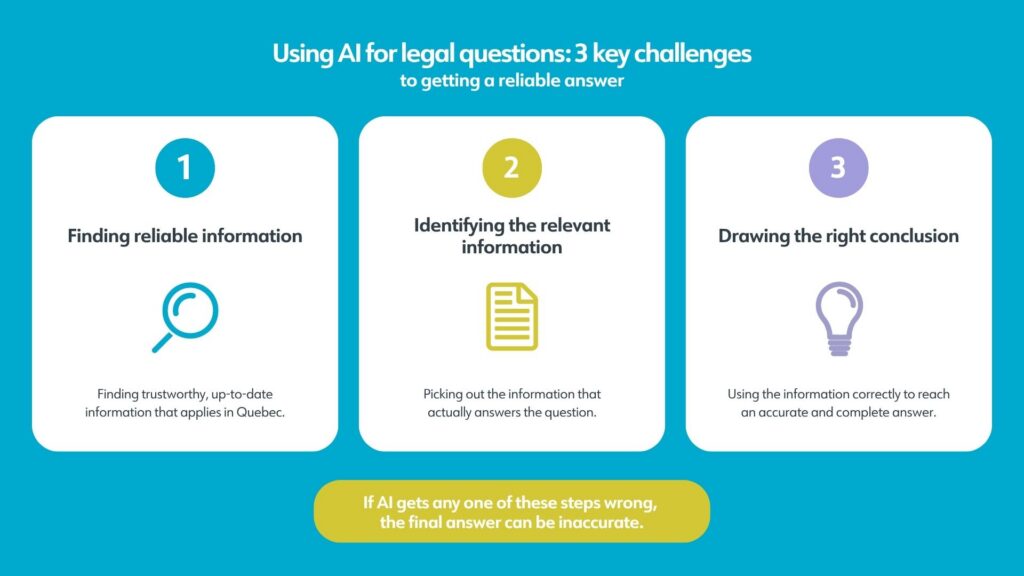
Third challenge: Arriving at a conclusion based on imperfect information
This is where things get even more complicated. AI is designed to produce an answer. When it doesn’t find exactly what is being looked for, it might try to complete the missing pieces by making assumptions.
Let’s get back to our pony. AI might reason as follows:
- Some service animals are allowed in courthouses.
- A pony can be a service animal.
- Therefore, a service pony should be able to enter a courthouse.
The reasoning is coherent and the conclusion seems logical, but it could still be wrong. A pony comes with very different issues than a dog: space, safety, getting around, furnishings, etc. A general rule can therefore have conditions attached that are not explicitly spelled out in the texts that AI reads.
This is probably one of our biggest lessons from our experiments: an answer can seem perfectly logical without being legally accurate.
A strength that’s also a weakness
These three steps show why it’s still very difficult to guarantee the reliability of legal AI when a question doesn’t fit a situation that’s been clearly explained in the source material. But our testing taught us more than that.
AI is particularly efficient to search for information based on how a person describes their problem themselves. No need to know the right legal term, to scroll through many menus or to guess which article in a law addresses their concern.
For well-documented and well-defined situations, AI can therefore help find relevant information quickly and present it using words that are consistent with the question asked.
The problem is that it can be almost as convincing when it’s mistaken. Our experiments have often made us think of this comparison: AI sometimes seems like a very motivated legal intern who absolutely wants to answer the question. It searches quickly, compiles the information, and confidently offers a conclusion, but AI doesn’t always have sufficient mastery of the subject to know when it should instead say, “I don’t know.”
That’s why, at this stage in our experimentation, human double-checking and oversight remain essential when we’re considering relying on a legal answer produced by AI.

Me Frédérick Roussel, Executive Director