






Can you bring a service dog into a restaurant? Can a landlord refuse an emotional support animal in a rental unit?
In Quebec, the answer depends on what role the animal plays. Service dogs generally have stronger legal protections and access rights than emotional support animals. Here’s what you need to know.

The difference between a service dog and an emotional support animal
Understanding the difference matters because the law treats them differently.
A service dog is specially trained to help a person with a disability. The dog performs specific tasks that help the person live more independently and safely. For example, a service dog may:
- guide someone who is blind or visually impaired,
- detect a seizure or low blood sugar,
- open doors,
- pick up objects,
- interrupt a panic attack or dissociative episode,
- help someone maintain their balance.
Service dogs can support people with many different disabilities, including:
- autism spectrum disorder,
- diabetes,
- epilepsy,
- reduced mobility,
- post-traumatic stress disorder (PTSD),
- hearing loss,
- visual impairment.
Many service dogs wear a harness, vest, scarf or badge showing they’ve received specialized training. Their handler may also have documentation on them related to the dog’s training.
Emotional support animals play a different role. They provide comfort and emotional support to people living with mental health conditions like anxiety or panic disorders.
Unlike service dogs, emotional support animals are generally not trained to perform specific tasks. However, they can still play an important role in a person’s well-being and mental health.
Can you go into a business or restaurant with a service dog?
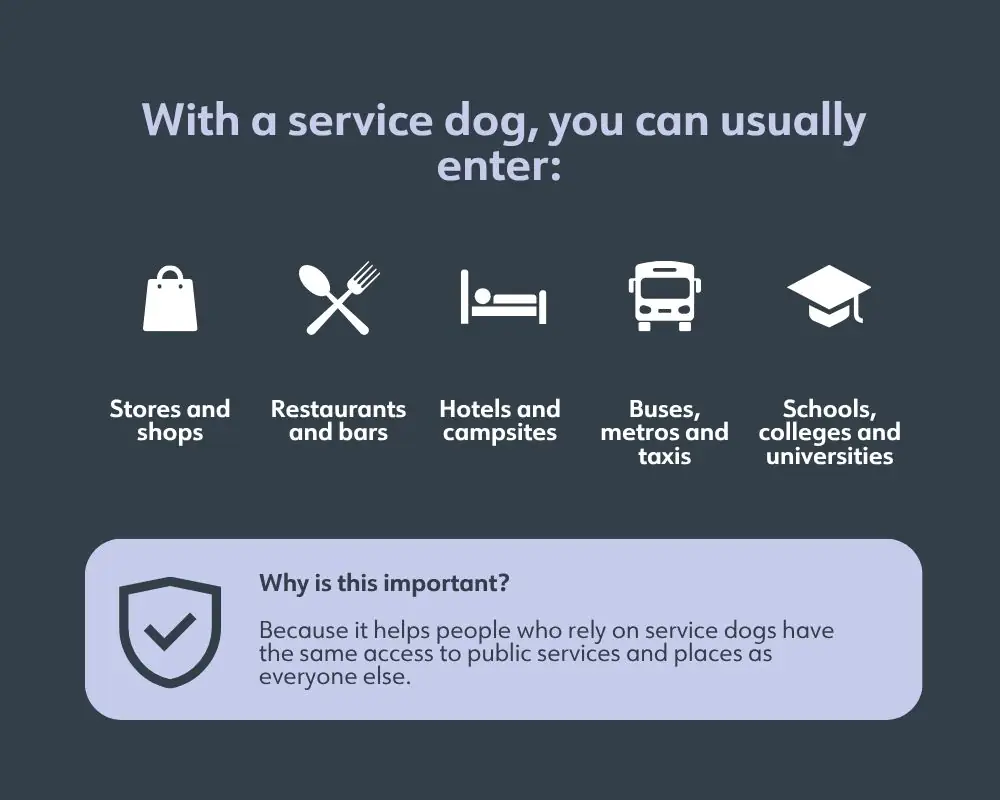
In most cases, yes. People who use service dogs generally have the right to access the same places and services as everyone else. This includes:
- stores and shops,
- restaurants and bars,
- hotels, inns and campsites,
- public transportation and taxis,
- schools, colleges and universities.
A business generally can’t refuse entry, charge extra fees or isolate someone from other customers because they’re accompanied by a service dog.
This protection comes from Quebec’s Charter of Human Rights and Freedoms, which prohibits discrimination based on disability. Courts have recognized that service dogs help people manage their disabilities and participate fully in daily life.
|
Important! There are some exceptions. An organization can refuse access if allowing the dog would create “undue hardship”, which is to say a serious health or safety risk or significant operational difficulties. For example, access could be restricted in certain specialized medical areas, like an operating room. However, a fear of dogs or a mild allergy is generally not enough on its own to justify refusing access. |
Can an organization ask for proof?
An organization is allowed ask questions to understand whether a dog is assisting a person with a disability or request documentation showing that the dog has received training. However, organizations generally can’t:
- require proof of the person’s disability,
- ask for medical information,
- automatically deny access because the person doesn’t have documentation with them.
What about emotional support animals?
Emotional support animals don’t automatically have the same access rights as service dogs. Whether they can enter a public place is usually decided on a case-by-case basis.
That doesn’t mean they’re automatically excluded. A person can ask to be accompanied by an emotional support animal. The organization must then consider the request. Factors that may be considered include:
- the animal’s behaviour,
- any health or safety risks,
- whether there are reasonable ways to accommodate the person’s needs.
Housing rights
Landlords can’t discriminate against someone because of a disability. This means that landlords generally can’t refuse a service dog, even if the lease doesn’t allow pets.
For emotional support animals, the situation is more complex. In some cases, Quebec’s housing court (the Tribunal administratif du logement) has allowed tenants to keep an emotional support animal despite a no-pets clause. To obtain this protection, tenants usually need to show that the animal is necessary for their mental health or well-being, for example by providing supporting medical documentation.