






You’re preparing a document for court and you ask an artificial intelligence (AI) tool for help. In a few seconds, AI gives you a detailed answer and lists court decisions that seem to support your argument.
Before using an answer generated by IA, you need to check its accuracy. AI tools can make mistakes, provide information that doesn’t apply in Quebec, or even invent court judgments. Once you’re in court, you’re responsible for the information you file with the court, even if an error is caused by an AI tool.

Mistakes that can be costly
You may have to pay money to the other side if you use answers provided by AI without double-checking them.
Quebec courts have already issued penalties to people who provided false answers generated by AI in a document filed with a court:
- In August 2026, the Court of Appeal of Quebec ordered a person to pay $1,000 for having filed with the court many non-existent judgments generated by AI.
- In 2025, the Superior Court fined a person who was representing themselves $5,000. Their document included non-existent decisions and incorrect legal sources generated by AI.
Why do courts do this? Because a wrong answer generated by AI can make the court and the other side waste time looking for a judgment that doesn’t exist or checking an argument based on a false legal source.
Is there any way to use AI to prepare a court case?
Yes, but some uses are much less risky than others.
For example, AI can help you:
- organise your thoughts,
- structure a document,
- make a text clearer,
- understand certain words or legal concepts,
- summarize a judgment that you found in a reliable legal source,
- prepare questions to ask a legal professional.
Even for these tasks, take the time to reread the result and to double-check key information.
On the other hand, it’s much riskier to ask AI to:
- find judgments that support your arguments,
- determine which legal rule applies to your situation,
- choose the evidence to present in court,
- predict what a court will decide.
These questions often require legal analysis. The answer can depend on specific details: the facts concerning your situation, the dates, applicable laws, exceptions and decisions already made by the courts.
AI can therefore miss something significant, interpret a rule incorrectly, or simply invent an answer.
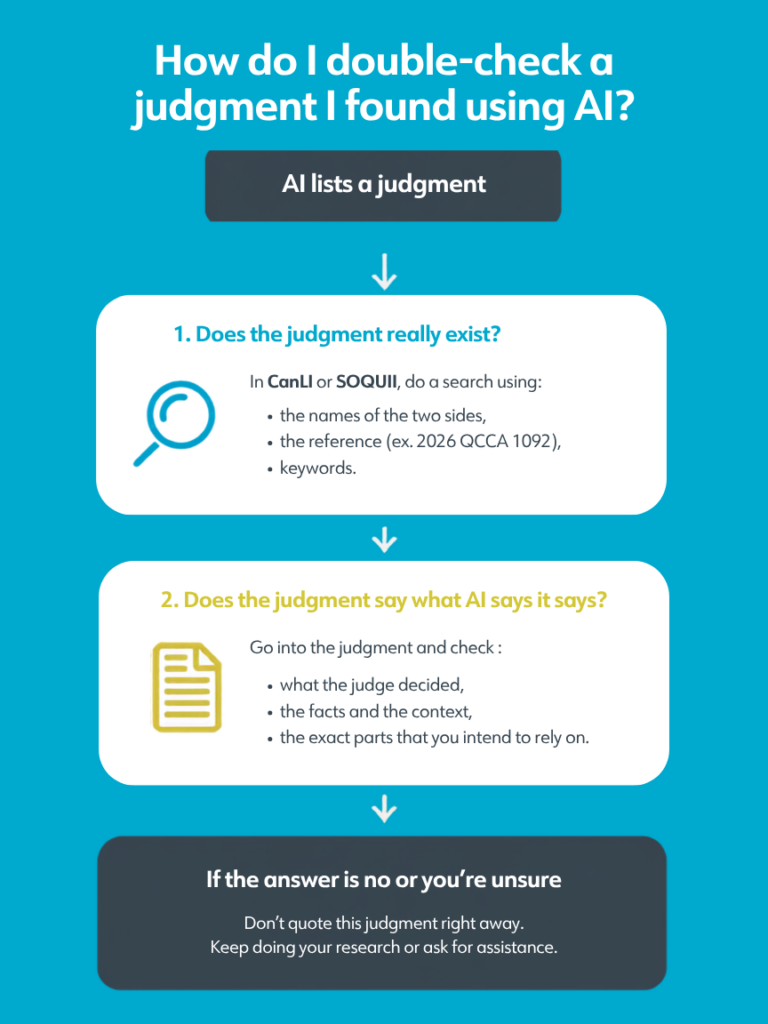
How to double-check a judgment listed by AI?
A little double-checking can keep you from filing a non-existent judgment or incorrect information with the court.
1. Check that the judgment exists
Don’t rely only on the name of the judgment or the summary provided by AI. Go find the judgment in a reliable legal database, like CanLii or SOQUIJ. You can search using :
- le nom des parties,
- la référence de la décision, par exemple 2026 QCCA 1092,
- des mots-clés liés au sujet.
2. Open the judgment and check what it really says
Finding the judgment isn’t enough. AI can list a real decision but be wrong when it explains what it says. Or AI might say that a decision stands for a rule that it doesn’t even mention. You should therefore go into the judgment and check:
- what the judge really decided,
- the facts and the context of the case,
- the specific part that you want to rely on.
You can’t find the judgment? You don’t see the part of the judgment that AI pointed you to? You’re best to keep researching or ask for help from a lawyer or notary before using this information in court.
Need help representing yourself in court?
There are many resources that can assist you.
- Éducaloi : Plain language explanations to help you understand your rights, your responsibilities, and how the court system works.
- CanLii and SOQUIJ: To search for and read court judgments.
- Info Justice: For free legal information, guidance or support, everywhere in Quebec.
Develop this reflex
AI can be very useful as a work aid, but it shouldn’t be treated like a legal reference tool.
If AI points you to a decision or gives you a reference, always go back to the original source before relying on it in court. And don’t hesitate to ask for help from a lawyer or notary.